字符串匹配算法 问题分析 字符串匹配问题的形式定义
文本(Text)是一个长度为 n 的数组 T[1..n];
模式(Pattern)是一个长度为 m 且 m≤n 的数组 P[1..m];
T 和 P 中的元素都属于有限的字母表 Σ 表;
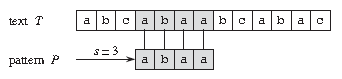
如果 0≤s≤n-m,并且 T[s+1..s+m] = P[1..m],即对 1≤j≤m,有 T[s+j] = P[j],则说模式 P 在文本 T 中出现且位移为 s,且称 s 是一个有效位移(Valid Shift)。
比如上图中,目标是找出所有在文本 T = abcabaabcabac 中模式 P = abaa 的所有出现。该模式在此文本中仅出现一次,即在位移 s = 3 处,位移 s = 3 是有效位移。
解决字符串匹配的算法包括
朴素算法(Naive Algorithm)
Rabin-Karp 算法
有限自动机算法(Finite Automation)
Knuth-Morris-Pratt 算法(即 KMP Algorithm)
Boyer-Moore 算法、Simon 算法、Colussi 算法
Galil-Giancarlo 算法、Apostolico-Crochemore 算法
Horspool 算法和 Sunday 算法等
基本步骤和算法效率
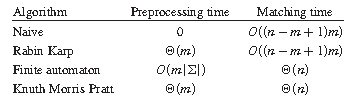
字符串匹配算法通常分为两个步骤:预处理(Preprocessing)和匹配(Matching)。所以算法的总运行时间为预处理和匹配的时间的总和。
上图描述了常见字符串匹配算法的预处理和匹配时间。
1 朴素的字符串匹配算法(Naive String Matching Algorithm) 基本思想
算法原理 1 2 3 4 5 6 1 NAIVE-STRING-MATCHER(T, P) 2 n ← length[T] 3 m ← length[P] 4 for s ← 0 to n - m 5 do if P[1 .. m] = T[s + 1 .. s + m] 6 then print "Pattern occurs with shift" s
如上图中,对于模式 P = aab 和文本 T = acaabc,将模式 P 沿着 T 从左到右滑动,逐个比较字符以判断模式 P 在文本 T 中是否存在。
NAIVE-STRING-MATCHER时间效率
可以看出,NAIVE-STRING-MATCHER 没有对模式 P 进行预处理,所以预处理的时间为 0。而匹配的时间在最坏情况下为 Θ((n-m+1)m),如果 m = [n/2],则为 Θ(n2)。
NAIVE-STRING-MATCHER 的代码示例。 1 2 3 4 5 6 7 8 9 10 11 12 13 14 15 16 17 18 19 20 21 22 23 24 25 26 27 28 29 30 31 32 33 34 35 36 37 38 39 40 41 42 43 44 45 46 47 48 49 50 51 52 53 54 55 56 57 58 59 60 61 62 63 64 65 66 67 68 69 70 71 72 73 74 75 76 77 78 79 80 81 82 83 84 85 86 87 88 89 90 91 92 93 94 95 96 97 98 99 100 101 102 103 104 105 106 107 108 109 110 111 112 113 114 115 116 117 118 119 120 121 122 123 124 125 126 127 128 129 130 131 132 133 134 135 136 1 namespace StringMatching 2 { 3 class Program 4 { 5 static void Main (string[] args) 6 { 7 char [] text1 = "BBC ABCDAB ABCDABCDABDE" .ToCharArray(); 8 char [] pattern1 = "ABCDABD" .ToCharArray(); 9 10 int firstShift1; 11 bool isMatched1 = NaiveStringMatcher.TryMatch1(text1, pattern1, out firstShift1); 12 Contract.Assert(isMatched1); 13 Contract.Assert(firstShift1 == 15 ); 14 15 char [] text2 = "ABABDAAAACAAAABCABAB" .ToCharArray(); 16 char [] pattern2 = "AAACAAAA" .ToCharArray(); 17 18 int firstShift2; 19 bool isMatched2 = NaiveStringMatcher.TryMatch2(text2, pattern2, out firstShift2); 20 Contract.Assert(isMatched2); 21 Contract.Assert(firstShift2 == 6 ); 22 23 char [] text3 = "ABAAACAAAAAACAAAABCABAAAACAAAAFDLAAACAAAAAACAAAA" .ToCharArray(); 24 char [] pattern3 = "AAACAAAA" .ToCharArray(); 25 26 int [] shiftIndexes = NaiveStringMatcher.MatchAll(text3, pattern3); 27 Contract.Assert(shiftIndexes.Length == 5 ); 28 Contract.Assert(string.Join("," , shiftIndexes) == "2,9,22,33,40" ); 29 30 Console.WriteLine("Well done!" ); 31 Console.ReadKey(); 32 } 33 } 34 35 public class NaiveStringMatcher 36 { 37 public static bool TryMatch1 (char [] text, char [] pattern, out int firstShift) 38 { 39 firstShift = -1 ; 40 int n = text.Length; 41 int m = pattern.Length; 42 int s = 0 , j = 0 ; 43 44 45 for (s = 0 ; s < n - m; s++) 46 { 47 for (j = 0 ; j < m; j++) 48 { 49 if (text[s + j] != pattern[j]) 50 { 51 break ; 52 } 53 } 54 if (j == m) 55 { 56 firstShift = s; 57 return true ; 58 } 59 } 60 61 return false ; 62 } 63 64 public static bool TryMatch2 (char [] text, char [] pattern, out int firstShift) 65 { 66 firstShift = -1 ; 67 int n = text.Length; 68 int m = pattern.Length; 69 int s = 0 , j = 0 ; 70 71 72 while (s < n && j < m) 73 { 74 if (text[s] == pattern[j]) 75 { 76 s++; 77 j++; 78 } 79 else 80 { 81 s = s - j + 1 ; 82 j = 0 ; 83 } 84 85 if (j == m) 86 { 87 firstShift = s - j; 88 return true ; 89 } 90 } 91 92 return false ; 93 } 94 95 public static int [] MatchAll(char [] text, char [] pattern) 96 { 97 int n = text.Length; 98 int m = pattern.Length; 99 int s = 0 , j = 0 ; 100 int [] shiftIndexes = new int [n - m + 1 ];101 int c = 0 ;102 103 104 while (s < n && j < m)105 {106 if (text[s] == pattern[j])107 {108 s++;109 j++;110 }111 else 112 {113 s = s - j + 1 ;114 j = 0 ;115 }116 117 if (j == m)118 {119 shiftIndexes[c] = s - j;120 c++;121 122 s = s - j + 1 ;123 j = 0 ;124 }125 }126 127 int [] shifts = new int [c];128 for (int y = 0 ; y < c; y++)129 {130 shifts[y] = shiftIndexes[y];131 }132 133 return shifts;134 }135 }136 }
上面代码中 TryMatch1 和 TryMatch2 分别使用 for 和 while 循环达到相同效果。
2 Knuth-Morris-Pratt 字符串匹配算法(即 KMP 算法) 基本思想
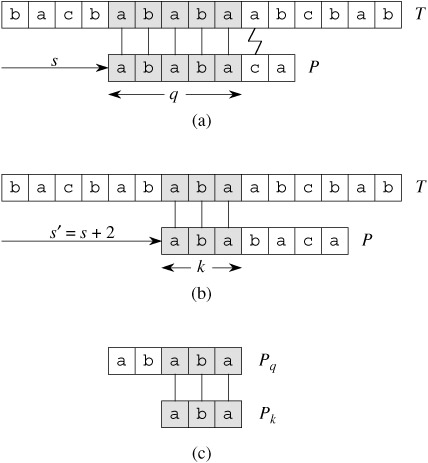
我们来观察一下朴素的字符串匹配算法的操作过程。如下图(a)中所描述,在模式 P = ababaca 和文本 T 的匹配过程中,模板的一个特定位移 s,q = 5 个字符已经匹配成功,但模式 P 的第 6 个字符不能与相应的文本字符匹配。
此时,q 个字符已经匹配成功的信息确定了相应的文本字符,而知道这 q 个文本字符,就使我们能够立即确定某些位移是非法的。例如上图(a)中,我们可以判断位移 s+1 是非法的,因为模式 P 的第一个字符 a 将与模式的第二个字符 b 匹配的文本字符进行匹配,显然是不匹配的。而图(b)中则显示了位移 s’ = s+2 处,使模式 P 的前三个字符和相应的三个文本字符对齐后必定会匹配。KMP 算法的基本思路就是设法利用这些已知信息,不要把 “搜索位置” 移回已经比较过的位置,而是继续把它向后面移,这样就提高了匹配效率。
算法原理
The basic idea behind KMP’s algorithm is: whenever we detect a mismatch (after some matches), we already know some of the characters in the text (since they matched the pattern characters prior to the mismatch). We take advantage of this information to avoid matching the characters that we know will anyway match.
已知模式 P[1..q] 与文本 T[s+1..s+q] 匹配,那么满足 P[1..k] = T[s’+1..s’+k] 其中 s’+k = s+q 的最小位移 s’ > s 是多少?这样的位移 s’ 是大于 s 的但未必非法的第一个位移,因为已知 T[s+1..s+q] 。在最好的情况下有 s’ = s+q,因此立刻能排除掉位移 s+1, s+2 .. s+q-1。在任何情况下,对于新的位移 s’,无需把 P 的前 k 个字符与 T 中相应的字符进行比较,因为它们肯定匹配。
可以用模式 P 与其自身进行比较,以预先计算出这些必要的信息。例如上图(c)中所示,由于 T[s’+1..s’+k] 是文本中已经知道的部分,所以它是字符串 Pq 的一个后缀。
此处我们引入模式的前缀函数 π(Pai),π 包含有模式与其自身的位移进行匹配的信息。这些信息可用于避免在朴素的字符串匹配算法中,对无用位移进行测试。
π[q] 代表当前字符之前的字符串中,最长的共同前缀后缀的长度。(π[q] is the length of the longest prefix of P that is a proper suffix of Pq.)
计算过程:
π[1] = 0,a 仅一个字符,前缀和后缀为空集,共有元素最大长度为 0;
π[2] = 0,ab 的前缀 a,后缀 b,不匹配,共有元素最大长度为 0;
π[3] = 1,aba,前缀 a ab,后缀 ba a,共有元素最大长度为 1;
π[4] = 2,abab,前缀 a ab aba,后缀 bab ab b,共有元素最大长度为 2;
π[5] = 3,ababa,前缀 a ab aba abab,后缀 baba aba ba a,共有元素最大长度为 3;
π[6] = 4,ababab,前缀 a ab aba abab ababa,后缀 babab abab bab ab b,共有元素最大长度为 4;
π[7] = 5,abababa,前缀 a ab aba abab ababa ababab,后缀 bababa ababa baba aba ba a,共有元素最大长度为 5;
π[8] = 6,abababab,前缀 .. ababab ..,后缀 .. ababab ..,共有元素最大长度为 6;
π[9] = 0,ababababc,前缀和后缀不匹配,共有元素最大长度为 0;
π[10] = 1,ababababca,前缀 .. a ..,后缀 .. a ..,共有元素最大长度为 1;
算法原理
KMP 算法 KMP-MATCHER 中通过调用 COMPUTE-PREFIX-FUNCTION 函数来计算部分匹配表。
1 2 3 4 5 6 7 8 9 10 11 12 13 1 KMP-MATCHER(T, P) 2 n ← length[T] 3 m ← length[P] 4 π ← COMPUTE-PREFIX-FUNCTION(P) 5 q ← 0 //Number of characters matched. 6 for i ← 1 to n //Scan the text from left to right. 7 do while q > 0 and P[q + 1] ≠ T[i] 8 do q ← π[q] //Next character does not match. 9 if P[q + 1] = T[i] 10 then q ← q + 1 //Next character matches. 11 if q = m //Is all of P matched? 12 then print "Pattern occurs with shift" i - m 13 q ← π[q] //Look for the next match.
1 2 3 4 5 6 7 8 9 10 11 1 COMPUTE-PREFIX-FUNCTION(P) 2 m ← length[P] 3 π[1] ← 0 4 k ← 0 5 for q ← 2 to m 6 do while k > 0 and P[k + 1] ≠ P[q] 7 do k ← π[k] 8 if P[k + 1] = P[q] 9 then k ← k + 1 10 π[q] ← k 11 return π
预处理过程 COMPUTE-PREFIX-FUNCTION 的运行时间为 Θ(m),KMP-MATCHER 的匹配时间为 Θ(n)。
相比较于 NAIVE-STRING-MATCHER,KMP-MATCHER 的主要优化点就是在当确定字符不匹配时对于 pattern 的位移。
NAIVE-STRING-MATCHER 的位移效果是:文本向后移一位,模式从头开始。
KMP-MATCHER 首先对模式做了获取共同前缀后缀最大长度的预处理操作,位移过程是先将模式向后移 partial_match_length - table[partial_match_length - 1],然后再判断是否匹配。这样通过对已匹配字符串的已知信息的利用,可以有效节省比较数量。
1 2 3 4 if (j != 0) j = lps[j - 1]; else s++;
下面描述了当发现字符 j 与 c 不匹配时的位移效果。
1 2 3 4 5 6 7 8 9 10 11 12 13 14 15 16 17 18 19 20 // partial_match_length - table[partial_match_length - 1] rrababababjjjjjiiooorababababcauuu ||||||||- ababababca // 8-6=2 rrababababjjjjjiiooorababababcauuu xx||||||- ababababca // 6-4=2 rrababababjjjjjiiooorababababcauuu xx||||- ababababca // 4-2=2 rrababababjjjjjiiooorababababcauuu xx||- ababababca // 2-0=2 rrababababjjjjjiiooorababababcauuu xx- ababababca
综上可知,KMP 算法的主要特点是:
需要对模式字符串做预处理;
预处理阶段需要额外的 O(m) 空间和复杂度;
匹配阶段与字符集的大小无关;
匹配阶段至多执行 2n - 1 次字符比较;
对模式中字符的比较顺序时从左到右;
算法实现
1 2 3 4 5 6 7 8 9 10 11 12 13 14 15 16 17 18 19 20 21 22 23 24 25 26 27 28 29 30 31 32 33 34 35 36 37 38 39 40 41 42 43 44 45 46 47 48 49 50 51 52 53 54 55 56 57 58 59 60 61 62 63 64 65 66 67 68 69 70 71 72 73 74 75 76 77 78 79 80 81 82 83 84 85 86 87 88 89 90 91 92 93 94 95 96 97 98 99 100 101 102 103 104 105 106 107 108 109 110 111 112 113 114 115 116 117 118 119 120 121 122 123 124 125 126 127 128 129 130 131 132 133 134 135 136 137 138 139 140 141 142 143 144 145 146 147 148 149 150 151 152 153 154 155 156 157 158 159 160 161 162 163 164 165 166 167 168 169 170 171 172 173 174 175 176 177 178 179 180 181 182 183 184 185 186 187 188 189 190 191 192 193 194 195 196 197 198 199 200 201 202 203 204 205 206 207 208 209 210 211 212 213 214 215 216 217 218 219 220 221 222 223 224 225 226 227 228 229 230 231 232 233 234 235 236 237 238 239 240 241 242 243 244 245 246 247 248 249 250 251 252 253 254 255 256 257 258 259 260 261 262 263 264 265 266 267 268 269 270 271 272 273 274 275 276 277 278 279 280 281 1 namespace StringMatching 2 { 3 class Program 4 { 5 static void Main (string[] args) 6 { 7 char [] text1 = "BBC ABCDAB ABCDABCDABDE" .ToCharArray(); 8 char [] pattern1 = "ABCDABD" .ToCharArray(); 9 10 int firstShift1; 11 bool isMatched1 = KmpStringMatcher.TryMatch1(text1, pattern1, out firstShift1); 12 Contract.Assert(isMatched1); 13 Contract.Assert(firstShift1 == 15 ); 14 15 char [] text2 = "ABABDAAAACAAAABCABAB" .ToCharArray(); 16 char [] pattern2 = "AAACAAAA" .ToCharArray(); 17 18 int firstShift2; 19 bool isMatched2 = KmpStringMatcher.TryMatch2(text2, pattern2, out firstShift2); 20 Contract.Assert(isMatched2); 21 Contract.Assert(firstShift2 == 6 ); 22 23 char [] text3 = "ABAAACAAAAAACAAAABCABAAAACAAAAFDLAAACAAAAAACAAAA" .ToCharArray(); 24 char [] pattern3 = "AAACAAAA" .ToCharArray(); 25 26 int [] shiftIndexes3 = KmpStringMatcher.MatchAll1(text3, pattern3); 27 Contract.Assert(shiftIndexes3.Length == 5 ); 28 Contract.Assert(string.Join("," , shiftIndexes3) == "2,9,22,33,40" ); 29 int [] shiftIndexes4 = KmpStringMatcher.MatchAll2(text3, pattern3); 30 Contract.Assert(shiftIndexes4.Length == 5 ); 31 Contract.Assert(string.Join("," , shiftIndexes4) == "2,9,22,33,40" ); 32 33 Console.WriteLine("Well done!" ); 34 Console.ReadKey(); 35 } 36 } 37 38 public class KmpStringMatcher 39 { 40 public static bool TryMatch1 (char [] text, char [] pattern, out int firstShift) 41 { 42 43 int [] lps = PreprocessToComputeLongestProperPrefixSuffixArray(pattern); 44 45 46 47 48 49 firstShift = -1 ; 50 int n = text.Length; 51 int m = pattern.Length; 52 int s = 0 , j = 0 ; 53 54 while (s < n && j < m) 55 { 56 if (j == -1 || text[s] == pattern[j]) 57 { 58 s++; 59 j++; 60 } 61 else 62 { 63 64 if (j != 0 ) 65 j = lps[j - 1 ]; 66 else 67 s++; 68 } 69 70 if (j == m) 71 { 72 firstShift = s - j; 73 return true ; 74 } 75 } 76 77 return false ; 78 } 79 80 static int [] PreprocessToComputeLongestProperPrefixSuffixArray(char [] pattern) 81 { 82 int m = pattern.Length; 83 84 85 int [] lps = new int [m]; 86 lps[0 ] = 0 ; 87 88 89 int k = 0 ; 90 int q = 1 ; 91 while (q < m) 92 { 93 if (pattern[k] == pattern[q]) 94 { 95 k++; 96 lps[q] = k; 97 q++; 98 } 99 else 100 {101 if (k != 0 )102 {103 k = lps[k - 1 ];104 }105 else 106 {107 lps[q] = 0 ;108 q++;109 }110 }111 }112 113 return lps;114 }115 116 public static bool TryMatch2 (char [] text, char [] pattern, out int firstShift) 117 {118 119 int [] next = PreprocessToGetNextArray(pattern);120 121 122 123 124 125 126 firstShift = -1 ;127 int n = text.Length;128 int m = pattern.Length;129 int s = 0 , j = 0 ;130 131 while (s < n && j < m)132 {133 if (j == -1 || text[s] == pattern[j])134 {135 s++;136 j++;137 }138 else 139 {140 141 j = next[j];142 }143 144 if (j == m)145 {146 firstShift = s - j;147 return true ;148 }149 }150 151 return false ;152 }153 154 static int [] PreprocessToGetNextArray(char [] pattern)155 {156 int m = pattern.Length;157 int [] next = new int [m];158 next[0 ] = -1 ;159 160 int k = -1 ;161 int q = 0 ;162 while (q < m - 1 )163 {164 if (k == -1 || pattern[k] == pattern[q])165 {166 k++;167 q++;168 169 170 171 if (pattern[k] != pattern[q])172 next[q] = k;173 else 174 next[q] = next[k]; 175 }176 else 177 {178 k = next[k];179 }180 }181 182 return next;183 }184 185 public static int [] MatchAll1(char [] text, char [] pattern)186 {187 188 int [] lps = PreprocessToComputeLongestProperPrefixSuffixArray(pattern);189 190 191 192 193 194 int n = text.Length;195 int m = pattern.Length;196 int s = 0 , j = 0 ;197 int [] shiftIndexes = new int [n - m + 1 ];198 int c = 0 ;199 200 while (s < n && j < m)201 {202 if (j == -1 || text[s] == pattern[j])203 {204 s++;205 j++;206 }207 else 208 {209 210 if (j != 0 )211 j = lps[j - 1 ];212 else 213 s++;214 }215 216 if (j == m)217 {218 shiftIndexes[c] = s - j;219 c++;220 221 j = lps[j - 1 ];222 }223 }224 225 int [] shifts = new int [c];226 for (int y = 0 ; y < c; y++)227 {228 shifts[y] = shiftIndexes[y];229 }230 231 return shifts;232 }233 234 public static int [] MatchAll2(char [] text, char [] pattern)235 {236 237 int [] next = PreprocessToGetNextArray(pattern);238 239 240 241 242 243 244 int n = text.Length;245 int m = pattern.Length;246 int s = 0 , j = 0 ;247 int [] shiftIndexes = new int [n - m + 1 ];248 int c = 0 ;249 250 while (s < n && j < m)251 {252 if (j == -1 || text[s] == pattern[j])253 {254 s++;255 j++;256 }257 else 258 {259 260 j = next[j];261 }262 263 if (j == m)264 {265 shiftIndexes[c] = s - j;266 c++;267 268 j = next[j - 1 ];269 }270 }271 272 int [] shifts = new int [c];273 for (int y = 0 ; y < c; y++)274 {275 shifts[y] = shiftIndexes[y];276 }277 278 return shifts;279 }280 }281 }