evans_test
Evans测试
一个模型“Foo”单元类,它根据“单元”支持转换和不同的刻度格式。 这里的“单位”只是一个标量转换因子,但是这个例子表明Matplotlib完全不知道客户端软件包使用哪种单位。

1 | from matplotlib.cbook import iterable |
下载这个示例
本博客所有文章除特别声明外,均采用 CC BY-NC-SA 4.0 许可协议。转载请注明来源 Estom的博客!
相关推荐

2021-09-02
01 Redis概述
Redis概述1 概述Redis 是速度非常快的非关系型(NoSQL)内存键值数据库,可以存储键和五种不同类型的值之间的映射。 键的类型只能为字符串,值支持五种数据类型:字符串、列表、集合、散列表、有序集合。 Redis 支持很多特性,例如将内存中的数据持久化到硬盘中,使用复制来扩展读性能,使用分片来扩展写性能。 优势使用Redis有哪些好处? 速度快,因为数据存在内存中,类似于HashMap,HashMap的优势就是查找和操作的时间复杂度都是O(1) 支持丰富数据类型,支持string,list,set,sorted set,hash 支持事务,操作都是原子性,所谓的原子性就是对数据的更改要么全部执行,要么全部不执行(4) 丰富的特性:可用于缓存,消息,按key设置过期时间,过期后将会自动删除 2 Redis 与 Memcached两者都是非关系型内存键值数据库,主要有以下不同: 数据类型。 Memcached 仅支持字符串类型, Redis 支持五种不同的数据类型,可以更灵活地解决问题。 数据持久化。 Redis 支持两种持久化策略:RDB 快照和 AOF 日志...

2021-12-24
dhcrelay
dhcrelay使用dhcrelay命令可以提供中继DHCP和BOOTP请求 补充说明dhcrelay命令 使用dhcrelay命令可以提供中继DHCP和BOOTP请求,从一个没有DHCP服务器的子网直接连接到其它子网内的一个或多个DHCP服务器。该命令在DHCP中继服务器上使用,同时支持DHCPv4/BOOTP和DHCPv6协议。 语法1dhcrelay [选项] [DHCP服务器] 选项1234567-c <跳数> 当转发数据包时,dhcrelay丢弃已经达到一个最大跳数的数据包。默认值是10,最大值是255-4 运行dhcrelay命令作为DHCPv4/BOOTP中继代理。这是默认操作模式-6 运行dhcrelay命令作为DHCPv6中继代理-q 安静模式-p <端口> 监听和发送端口。DHCPv4/BOOTP默认端口是67,DHCPv6默认端口是547-A <长度> 指定发送到DHCP服务器的最大数据包大小-d 强制dhcrelay命令作为前台进程运行 例子指定DHCP服务器的位置。 12345678910[root@lo...

2020-09-26
index
将Matplotlib嵌入图形用户界面中您可以通过此处的embedding_in_SOMEGUI.py示例将Matplotlib直接嵌入到用户界面中。 目前matplotlib支持wxpython,pygtk,tkinter 和 pyqt4 / 5。 在将Matplotlib嵌入GUI时,您应该直接使用Matplotlib API而不是pylab / pyplot的继续接口,因此请查看examples / api目录,了解使用API的一些示例代码。
2022-08-17
图解OSI七层网络模型
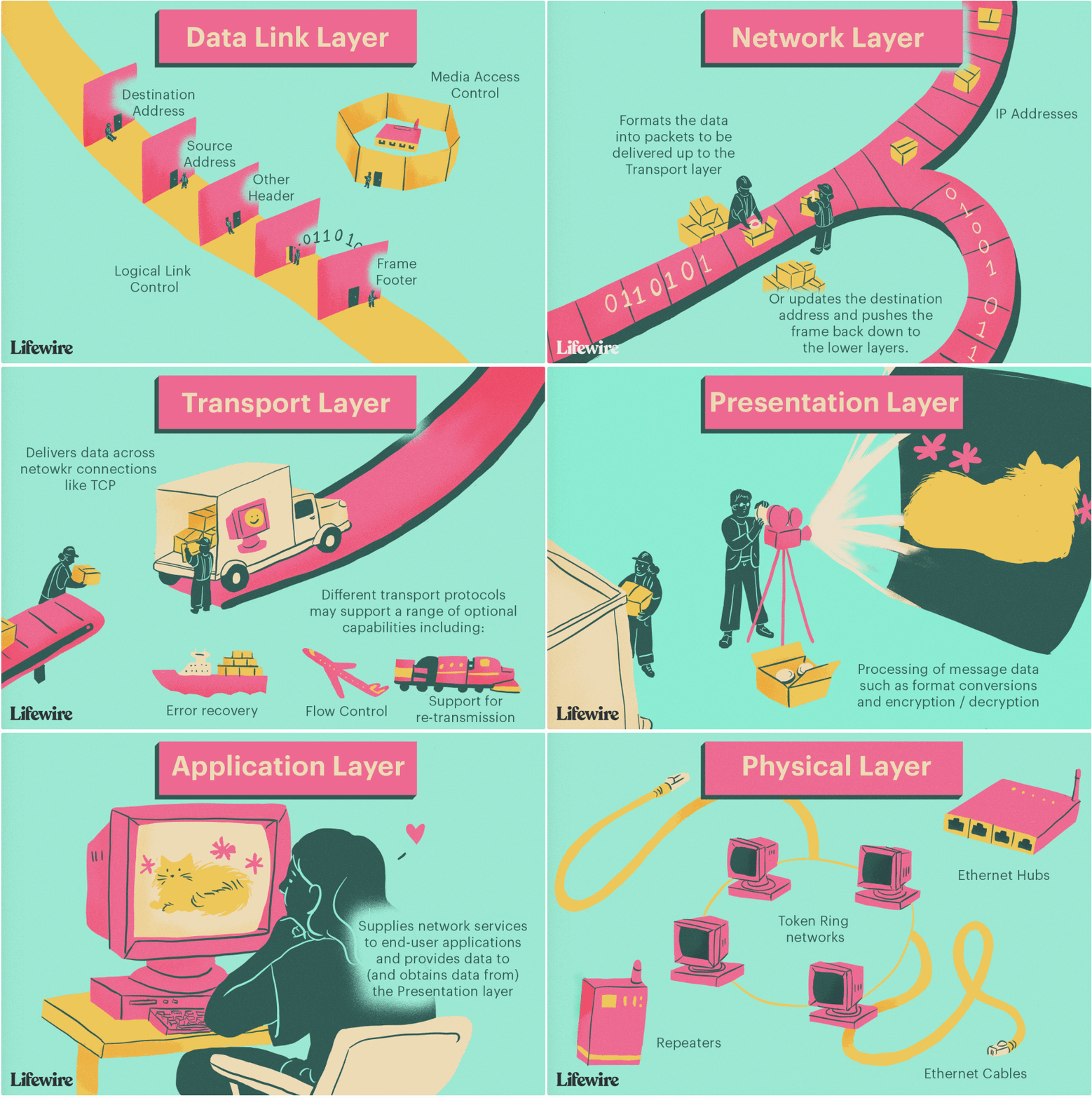
简单图解OSI七层网络模型 翻译自Bradley Mitchell的《The Layers of the OSI Model Illustrated》 Open Systems Interconnection(OSI)定义了一个网络框架,其以层为单位实现了各种协议,同时会将控制权逐层传递。目前OSI主要作为教学工具被使用,其在概念上将计算机网络结构按逻辑顺序划分为7层。 较低层处理电信号、二进制数据块以及路由这些数据以便在网络中的穿梭;从用户的角度来看,更高的层次包括网络请求和响应、数据的表示和网络协议。 OSI模型最初被认为是构建网络系统的标准体系结构,今天许多流行的网络技术都可以看出OSI的分层设计。 物理层(Physical Layer)物理层是OSI模型的第一层,其职责在于通过网络通信媒介将比特流数据从发送(源)设备的物理层传输到接收(终)设备的物理层。 第一层技术的例子包括以太网电缆和集线器。此外,集线器和其他中继器是在物理层起作用的标准网络设备,电缆连接器也是如此。 在物理层,数据通过物理介质支持的以下信号类型进行传输: 电压 无线电频率 红外脉冲 普通光 ...

2021-06-15
3 TLS协议变迁
1 TSL1.0概念 TLS(Transport Layer Security,传输层安全协议),用于两个应用程序之间提供保密性和数据完整性。 TLS 1.0是IETF(Internet Engineering Task Force,Internet工程任务组)制定的一种新的协议,它建立在SSL 3.0协议规范之上,是SSL 3.0的后续版本,可以理解为SSL 3.1(可简单理解为同一事物不同阶段的不同称呼),它是写入了 RFC 的。该协议由两层组成: TLS 记录协议(TLS Record)和 TLS 握手协议(TLS Handshake)。较低的层为 TLS 记录协议,位于某个可靠的传输协议(例如 TCP)上面。 特点 对话的内容用”对称加密”,而对于”对称加密”带来的密钥传输问题,则由”非对称加密”来解决,由于客户端没有”非对称加密”的解密能力,所以密钥由客户端来产生并用公钥加密传输给服务端,这样就(在思路上)解决了密钥传输的安全问题和对话数据解密的性能问题 技术2 TSL1.1特点 隐式初始化向量(IV)被显式IV替换以防止CBC攻击[CBCATT]。 填充错误的处...

2020-09-26
dfrac_demo
\dfrac 和 \frac之间的区别在此示例中,说明了 \dfrac和\frac TeX宏之间的差异; 特别是,使用Mathtex时显示样式和文本样式分数之间的差异。 New in version 2.1. 注意:要将 \dfrac与LaTeX引擎一起使用(text.usetex:True),您需要使用text.latex.preamble rc导入amsmath包,这是一个不受支持的功能; 因此,在 \frac宏之前使用 \displaystyle选项来获取LaTeX引擎的这种行为可能是个更好的主意。 12345678import matplotlib.pyplot as pltfig = plt.figure(figsize=(5.25, 0.75))fig.text(0.5, 0.3, r'\dfrac: $\dfrac{a}{b}$', horizontalalignment='center', verticalalignment='center')fi...