11 lambda表达式
lambda表达式
1 简介
对象分类
对象的分类
- 基础类型的对象
- 复合类型的对象
- 类类型的对象
- 函数对象
可调用对象
可调用对象是可以使用函数调用运算符()的对象。
- 函数
- 函数指针
- 重载了函数调用运算符的类
- lambda表达式
2 使用
Lambda表达式定义
- 形式。仅仅是形式上不同的函数。capture list捕获列表是外部的局部变量的列表,捕获后可以在函数内部使用。
1 | [capture list](parameter list) -> return type {function body} |
- 没有参数和返回值的lambda表达式
1 | auto l=[]{ |
- lambda表达式的定义完成后直接调用
1 | []{ cout<<"helloworld"<<endl;}(); |
- 有参数的lambda表达式
1 | auto l = [](int a,int b){cout<<a+b<<endl;}; |
- 有返回值的lambda表达式
1 | auto l = [](int m,int n)->int{cout<<m+n<<endl;return m+n;}; |
lambda表达式的调用
- 使用调用运算符进行调用
1 | auto f = []{return 42;}; |
- 使用lambda表达式和find_if算法
1 | //使用find_if和lambda表达式 |
- 使用lambda表达式和for_each算法
1 | // for_each给每一个元素的操作 |
捕获列表
- 捕获列表的捕获方式
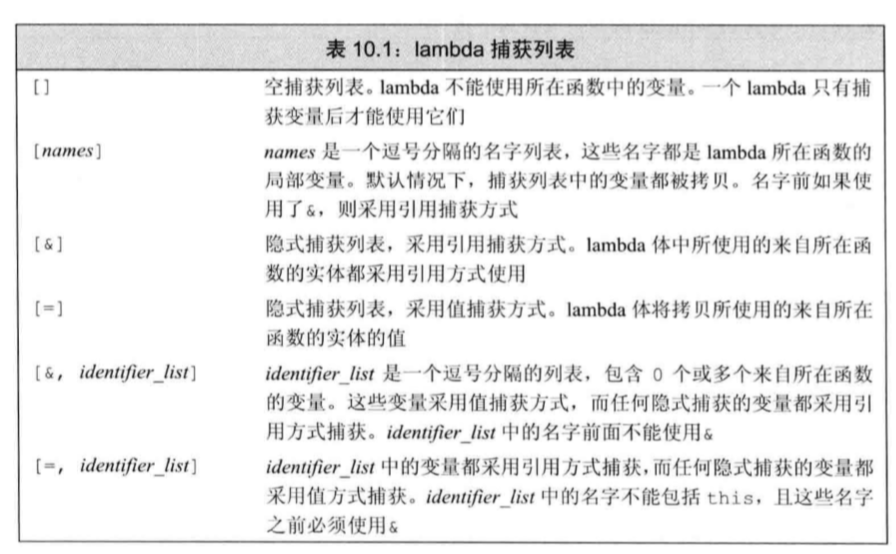
1 | int a = 1; |
返回类型
可以指定返回值的类型。
- 单个返回语句可以推断返回类型,不需要指定返回值类型
- 多个返回语句无法推断。需要指定返回类型。
1 | transoform(vi.begin(),vi.end(),vi.begin(), |
3 bind 参数绑定
lambda 表达式通常只在一个地方使用的简单操作。如果需要在多个地方使用相同的操作,通常定义一个函数,而不是多次编写相同的lambda表达式。
bind函数适配器,接受一个函数对象,生成一个行的可调用的对象。
1 | auto newCallable = bind(callable,arg_list); |
_1,_2分别表示新函数g的第一个和第二参数。
本博客所有文章除特别声明外,均采用 CC BY-NC-SA 4.0 许可协议。转载请注明来源 Estom的博客!
相关推荐

2021-03-06
13.动态内存管理实现
动态内存1 C中动态内存的实现概念 c 语言主要是使用malloc / calloc / realloc 来进行内存申请的。 共同点 都是从堆上进行动态内存分配 释放内存都是需要使用free函数来释放 三者的返回值都是void* 都需要强制类型转换 都需要对申请出的空间判空(因为申请内存失败会返回空) malloc1void *malloc( size_t size ); malloc的参数是用户所需内存空间大小的字节数,不会对申请成功的内存初始化。 malloc 申请空间时并不是需要多少就申请多少,而是会多申请一些空间, 多申请一个32字节的结构体,里面对申请的空间进行描述, 在申请的空间前后会各多申请 4 个字节的空间,这就是保护机制,当你操作不当越界了,这 8 个字节的内容会改变,操作系统会检查前后 4 个字节是否改变了,以此判断是否越界了。 calloc1void *calloc( size_t num, size_t size ); calloc的参数:第一个:元素的个数,第二个:单个元素所占字节;会把申请成功的空间初始化为 0 re...

2022-07-24
01 类型转换
基本类型的类型转换继承中的类型转换 向上转型。子类的对象可以转换成父类的变量。 向下转型。父类的变量可以转换成子类的变量。 验证3种情况 父类变量指向父类对象(父类方法)。父类变量强制转换子类变量(转换出错)。 子类变量指向子类对象(子类方法)。子类变量强制转换父类变量(多态子类方法)。 父类变量指向子类对象(多态子类方法)。父类变量强制转换子类变量(子类方法)。 1234567891011121314151617public class App02{ public static void main( String[] args ) { System.out.println( "Hello World!" ); Dog dd = new Dog(); Animal aa = new Animal(); Animal ad = new Dog(); dd.say(); //dog say ((Animal)dd).say();//dog s...

2021-04-14
1.3 自定义数据类型
自定义数据类型 自定义类型的变量,一般称为对象。 类类型类型定义包括以下两类成员 数据成员 成员函数 12345678class Data{public: int m; int n; int hello(){ return 1; }} 变量对象定义1Data a,b; 变量对象使用12a.m;a.hello(); 2 结构体类型类型定义12345struct data{ std::string bookNo; unsigned sold = 0; double revenue = 0.0;}; 变量对象定义变量对象使用3 枚举类型类型定义变量对象定义变量对象使用4 联合体类型类型定义变量对象定义变量对象使用

2022-04-18
17 json
JSON 全称为 JavaScript Object Notation,译为 JavaScript 对象表示法。是一种轻量级的数据交换格式。 官网地址: http://www.json.org/json-zh.html JSON 易于开发者阅读和编写,也易于计算机解析和生成。它基于JavaScript Programming Language,Standard ECMA-262 3rd Edition - December 1999的一个子集。 JSON 采用完全独立于语言的文本格式,被 Java、C#、C++、PHP、OC 等几乎所有主流语言所支持。 JSON 作为一种轻量级的文本数据交换格式,已被广泛使用于存储和交换文本数据领域。 语法规则JSON 构建于两种语法结构: “名称 / 值”对的集合。在 JavaScript 中被解释为 对象。 值的有序列表。在 JavaScript 中被解释为 数组。 JSON 存储数据的类型可以是字符串(string)、数值(number)、true、false、 null、对象(object)或者数组(array)。这...

2022-04-18
19 引用
引用类型通常被叫做类(class)。但在 ECMAScript 2015 版本之前的 JavaScript 中并没有类的概念,在 JavaScript 中通常叫做对象定义。 也就是说,使用引用类型其实就是使用对象(该内容在后面的章节学习)。 JavaScript 中预定义了很多的引用类型,其中包含之前学习的包装类型 Boolean、Number 和 String。 下述列表罗列了 JavaScript 中所提供的引用类型: 引用类型 说明 Date类型 获取和设置当前日期时间。 Math类型 用于数学计算。 Global类型 全局对象,提供全局属性和全局方法。 Array类型 用于有序的存储多个值。 RegExp类型 用于对字符串模式匹配及检索替换,是对字符串执行模式匹配的强大工具。 Error类型 用于匹配代码错误并提供对应提示内容。 Functions类型 用于定义 JavaScript 中的函数。 Object类型 用于定义 JavaScript 中的对象。 Date类型创建 Date 对象JavaScript 中并没有提供日期的...

2022-04-18
18 数组与遍历
类数组对象就是结构上类似于数组的对象,该对象具备数组的一些特性属性或方法,同时具有自己独特的一些属性或方法。 数组与类数组对象的区别 数组的类型是 Array 类数组对象的类型是 Object 类数组的操作 length属性:获取指定元素的个数。 eq(index):将下标等于index的DOM对象取出来。 get(index):返回一个DOM对象组成的数组。 index(obj):返回DOM或jQuery对象在类数组中的下标。 遍历方法$(selector).each(callback) 方法 callback:回调函数,function(index,domEle){} index:遍历过程中的索引值 domEle:遍历后得到的DOM对象 123$("input").each(function(index,domEle){ console.log(domEle.value);}); $.each(obj,callback) 方法 obj:需要遍历的对象或数组。 callback:回调函数,function(index,...