组合模式

意图

将对象组合成树形结构以表示 “部分-整体” 的层次结构。

Composite 使得用户对于单个对象和组合对象的使用具有一致性。

Compose objects into tree structures to represent part-whole hierarchies.

Composite lets clients treat individual objects and compositions of objects
uniformly.

结构
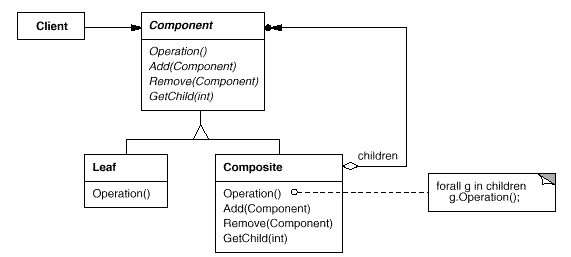
120166157079.png

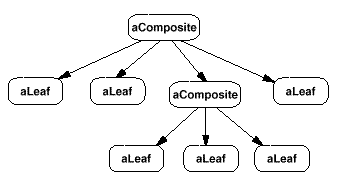
典型的 Composite 对象结构:

120529122324.png

参与者

Component

  • 为组合中的对象声明接口。

  • 在适当的情况下,实现所有类共有接口的缺省行为

  • 声明一个接口用于访问和管理 Component 的子组件。

  • 在递归结构中定义一个接口,用于访问一个父部件,并在合适的情况下实现它。

Leaf

  • 在组合中表示叶节点对象,叶节点没有子节点。

  • 在组合中定义图元对象的行为。

Composite

  • 定义有子部件的那些部件的行为。

  • 在 Composite 接口中实现与子部件有关的操作。

Client

  • 通过 Component 接口操纵组合部件的对象。

适用性

在以下情况下可以使用 Composite 模式:

  • 你想表示对象的 “部分-整体” 层次结构。

  • 你希望用户忽略组合对象与单个对象的不同,用户将统一地使用组合结构中的所有对象。

缺点

  • 与类层次结构设计原则冲突

Composite 模式的目的之一是使得用户不知道它们正在使用具体的 Leaf 和 Composite
类。

为达到这一目的,Component 需要为 Leaf 和 Composite
定义一些公共操作,并提供缺省的实现,而 Leaf 和 Composite
子类可以对它们进行重定义。

然而,这个目标会与类层次结构设计原则冲突,该原则规定:一个类只能定义那些对它的子类有意义的操作。

效果

  • 定义了包含基本对象和组合对象的类层次结构。

  • 简化客户代码。

  • 使得更容易增加新类型的组件。

  • 使你的设计变得更加一般化。

相关模式

  • Command 模式描述了如何用一个 MacroCommand Composite 类组成一些 Command
    对象,并对它们进行排序。

  • 通常 “部件-父部件” 连接用于 Responsibility of Chain 模式。

  • Decorator 模式经常与 Composite 模式一起使用。它们通常有一个公共的父类。

  • Flyweight 让你共享组件,但不再能引用它们的父部件。

  • Iterator 可以用来遍历 Composite。

  • Visitor 将本来应该分布在 Composite 和 Leaf 类中的操作和行为局部化。

Implementation

1
2
3
4
5
6
7
8
9
10
11
12
13
14
15
16
17
public abstract class Component {
protected String name;

public Component(String name) {
this.name = name;
}

public void print() {
print(0);
}

abstract void print(int level);

abstract public void add(Component component);

abstract public void remove(Component component);
}
1
2
3
4
5
6
7
8
9
10
11
12
13
14
15
16
17
18
19
20
21
22
23
24
25
26
27
28
29
30
public class Composite extends Component {

private List<Component> child;

public Composite(String name) {
super(name);
child = new ArrayList<>();
}

@Override
void print(int level) {
for (int i = 0; i < level; i++) {
System.out.print("--");
}
System.out.println("Composite:" + name);
for (Component component : child) {
component.print(level + 1);
}
}

@Override
public void add(Component component) {
child.add(component);
}

@Override
public void remove(Component component) {
child.remove(component);
}
}
1
2
3
4
5
6
7
8
9
10
11
12
13
14
15
16
17
18
19
20
21
22
23
public class Leaf extends Component {
public Leaf(String name) {
super(name);
}

@Override
void print(int level) {
for (int i = 0; i < level; i++) {
System.out.print("--");
}
System.out.println("left:" + name);
}

@Override
public void add(Component component) {
throw new UnsupportedOperationException(); // 牺牲透明性换取单一职责原则,这样就不用考虑是叶子节点还是组合节点
}

@Override
public void remove(Component component) {
throw new UnsupportedOperationException();
}
}
1
2
3
4
5
6
7
8
9
10
11
12
13
14
15
16
17
18
public class Client {
public static void main(String[] args) {
Composite root = new Composite("root");
Component node1 = new Leaf("1");
Component node2 = new Composite("2");
Component node3 = new Leaf("3");
root.add(node1);
root.add(node2);
root.add(node3);
Component node21 = new Leaf("21");
Component node22 = new Composite("22");
node2.add(node21);
node2.add(node22);
Component node221 = new Leaf("221");
node22.add(node221);
root.print();
}
}
1
2
3
4
5
6
7
Composite:root
--left:1
--Composite:2
----left:21
----Composite:22
------left:221
--left:3

JDK

  • javax.swing.JComponent#add(Component)
  • java.awt.Container#add(Component)
  • java.util.Map#putAll(Map)
  • java.util.List#addAll(Collection)
  • java.util.Set#addAll(Collection)