5.6 Product Trader(操盘手)
设计模式之美:Product Trader(操盘手)
索引
意图
结构
参与者
适用性
效果
相关模式
实现
实现方式(一):Product Trader 的示例实现。
意图
使客户程序可以通过命名抽象超类和给定规约来创建对象。
Product Trader 让客户程序与 Product
类解耦,从而使得类的层级结构、框架和应用程序易于改写、配置和演进。
Let clients create objects by naming an abstract superclass and by providing a
specification.
A Product Trader decouples the client from the product and thereby eases the
adaption, configuration and evolution of class hierarchies, frameworks and
applications.
结构
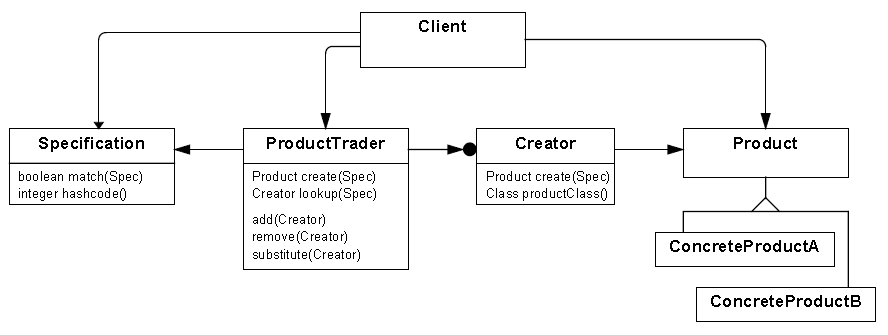
参与者
Client
为 ConcreteProduct 类创建 Specification。
为 Product Trader 提供 Specification 以初始话构建过程。
Product
- 定义类层次的接口。
ConcreteProduct
Product 抽象类的具体类。
提供足够的信息以判定是否满足 Specification。
ProductTrader
从 Client 接收一个 ConcreteProduct 对应的 Specification。
映射 Specification 和 Creator。
提供映射配置机制。
调用 Creator 以生成符合 Specification 的 ConcreteProduct。
Creator
定义创建 ConcreteProduct 实例的接口。
知道如何根据 Specification 创建合适的 ConcreteProduct。
Specification
一个 Specification 代表着一个 ConcreteProduct 类。
作为映射和查询 Creator 的条件参数。
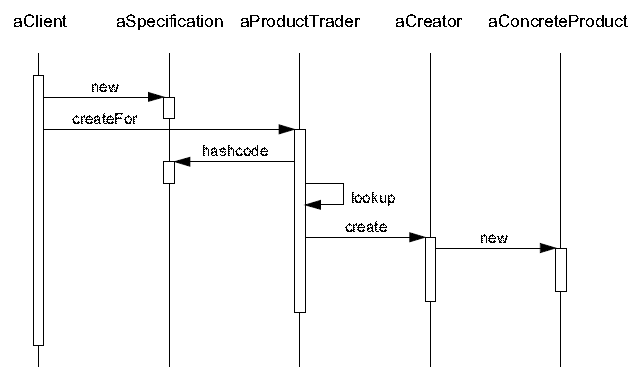
适用性
当以下情况成立时可以使用 Product Trader 模式:
当你想让客户程序完全独立于 Product 实体类的实现时。
你需要在运行时根据可用的规约条件动态的生成 Product 对象时。
你需要为给定的规约条件配置相应的 Product 类对象。
你需要在不影响客户代码的条件下修改和演进 Product 类的层次。
效果
Client 程序完全独立于 ConcreteProduct 类层次。
可以在运行时决定 Product 的具体类。
可以根据特定的领域对 Product 进行配置。
Product 类层次更易于演进。
衍生新的 ConcreteProduct 更加方便。
Product 类可以是负责的组件。
相关模式
- 可以尝试在 Factory Method 模式无法工作或不太适合时,尝试使用 Product
Trader。Factory Method 常使 Product 和 Creator 之间形成循环依赖。
实现
实现方式(一):Product Trader 的示例实现。
1 namespace ProductTraderPattern.Implementation1 2 { 3 public class
Specification 4 { 5 public string Criteria { get; set; } 6 7 public bool
IsSatisfiedBy(Product product) 8 { 9 return product.Criteria == this.Criteria;
10 } 11 12 public override int GetHashCode() 13 { 14 return
Criteria.GetHashCode(); 15 } 16 17 public override bool Equals(object obj) 18 {
19 return GetHashCode().Equals(obj.GetHashCode()); 20 } 21 } 22 23 public
abstract class Product 24 { 25 public abstract string Criteria { get; } 26 } 27
28 public class ConcreteProductA : Product 29 { 30 public override string
Criteria 31 { 32 get 33 { 34 return “SpecForConreteProductA”; 35 } 36 } 37 } 38
39 public class ConcreteProductB : Product 40 { 41 public override string
Criteria 42 { 43 get 44 { 45 return “SpecForConreteProductB”; 46 } 47 } 48 } 49
50 public abstract class ProductCreator 51 { 52 public abstract Product
Create(Specification spec); 53 } 54 55 public class ConcreteProductCreator :
ProductCreator 56 { 57 public override Product Create(Specification spec) 58 {
59 if (spec.Criteria == “SpecForConreteProductA”) 60 { 61 return new
ConcreteProductA(); 62 } 63 else if (spec.Criteria == “SpecForConreteProductB”)
64 { 65 return new ConcreteProductB(); 66 } 67 68 // any factory you can use
here 69 throw new NotSupportedException(); 70 } 71 } 72 73 public class
ProductTrader 74 { 75 private Dictionary<Specification, ProductCreator> _dict
76 = new Dictionary<Specification, ProductCreator>(); 77 78 public Product
CreateFor(Specification spec) 79 { 80 ProductCreator creator =
LookupCreator(spec); 81 Product product = creator.Create(spec); 82 return
product; 83 } 84 85 public ProductCreator LookupCreator(Specification spec) 86 {
87 return _dict[spec]; 88 } 89 90 public void AddCreator(Specification spec,
ProductCreator creator) 91 { 92 _dict.Add(spec, creator); 93 } 94 95 public
void RemoveCreator(Specification spec, ProductCreator creator) 96 { 97
_dict.Remove(spec); 98 } 99 100 public void SubstituteCreator(Specification
spec, ProductCreator creator) 101 { 102 _dict[spec] = creator; 103 } 104 } 105
106 public class Client 107 { 108 public void TestCase1() 109 { 110
Specification spec1 = new Specification(); 111 spec1.Criteria =
“SpecForConreteProductA”;112 113 Specification spec2 = new Specification(); 114
spec2.Criteria = “SpecForConreteProductA”;115 116 ProductCreator creator = new
ConcreteProductCreator(); 117 118 ProductTrader trader = new ProductTrader();
119 trader.AddCreator(spec1, creator); 120 trader.AddCreator(spec2, creator);
121 122 Specification spec3 = new Specification(); 123 spec3.Criteria =
“SpecForConreteProductA”;124 125 Product product = trader.CreateFor(spec3); 126
} 127 } 128 }