5.7 Role Object(角色对象)
索引
意图
结构
参与者
适用性
效果
相关模式
实现
- 实现方式(一):Role Object 的示例实现。
意图
通过明确地附加角色对象到目标对象中,以使对象可以适配不同的客户需求。每个角色对象都代表着目标对象在客户上下文中的一种角色。每种上下文都存在于特定的应用程序中,因此可使对象在不同的应用程序间解耦。
Adapt an object to different client’s needs through transparently attached role
objects, each one representing a role the object has to play in that client’s
context. Each context may be its own application, which therefore gets decoupled
from the other applications.
结构
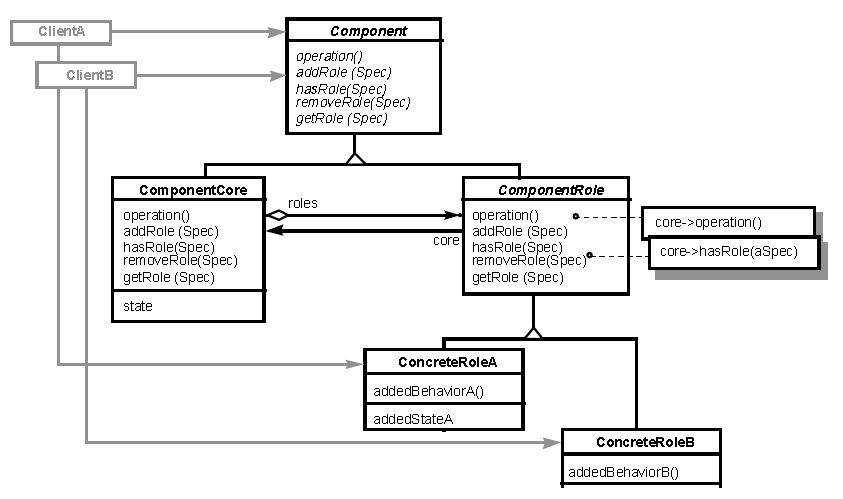
参与者
Component
定义关键的抽象接口。
定义添加、删除、测试和查询角色对象的接口协议。Client 可以指定一个
specification 来获取一个 ConcreteRole 实例。
ComponentCore
实现 Component 接口,包括角色管理协议。
负责创建 ConcreteRole 实例。
管理角色对象。
ComponentRole
存储一个经过装饰的 ComponentCore 对象的引用。
实现 Component 接口,并将接口请求转发到 ComponentCore 中。
ConcreteRole
定义和实现特定上下文的 Component 接口的实现。
构造函数包含一个 ComponentCore 参数。
Client
- 请求协作对象。
适用性
当以下情况成立时可以使用 Role Object 模式:
你需要在不同的客户上下文间保持关键的抽象定义,每种抽象定义的实现都存在于其特定的应用范围内,同时你不想将这些与客户上下文相关的接口耦合在同一个接口内。
你需要能够动态的处理角色,以便可以在运行时按需的添加或移除角色,而不是在编译时使用固定的对象定义。
你需要保持角色与客户成对儿关系,在不同的角色与客户对之间保持独立性,当更改一个角色时并不影响其他客户。
效果
可以简洁地定义对象的关键抽象。Component
接口仅需关注必要的状态的行为,而不会涉及具体上下文中的职责。角色对象易于演进,彼此之间保持独立。
角色对象可以动态的添加和移除。
应用程序可以更好的解耦和。
相关模式
Decorator 模式与 Role Object 模式有着类似的结构,但行为不同。Decorator
模式使开发人员可以对一个对象进行链式的装饰,而 Role Object
模式则不允许这样。并且,Decorator 通常不会扩大对象的功能,而 Role Object
会引入新的操作。Extension Object
模式也在解决类似的问题,通过对对象的扩展来满足特定的客户上下文的需求。尽管如此,Extension
Object 并没有考虑透明性(Transparently),即保持对象关键抽象(Key
Abstraction)的定义,而 Role Object 则正是强调了这一点。
实现
实现方式(一):Role Object 的示例实现。

复制代码
1 namespace RoleObjectPattern.Implementation1 2 { 3 public abstract class
Customer 4 { 5 public abstract CustomerRole GetRole(string spec); 6 public
abstract void AddRole(string spec); 7 public abstract void RemoveRole(string
spec); 8 public abstract bool HasRole(string spec); 9 public abstract void
SomeCommonOperation1(); 10 } 11 12 public class CustomerCore : Customer 13 { 14
private Dictionary<string, CustomerRole> _roles 15 = new Dictionary<string,
CustomerRole>(); 16 private CustomerRoleFactory _roleFactory; 17 18 public
CustomerCore(CustomerRoleFactory roleFactory) 19 { 20 _roleFactory =
roleFactory; 21 } 22 23 public override CustomerRole GetRole(string spec) 24 {
25 if (_roles.ContainsKey(spec)) 26 return _roles[spec]; 27 else 28 return
null; 29 } 30 31 public override void AddRole(string spec) 32 { 33 CustomerRole
role = GetRole(spec); 34 if (role == null) 35 { 36 role =
_roleFactory.CreateRole(spec, this); 37 if (role != null) 38 { 39
_roles.Add(spec, role); 40 } 41 } 42 } 43 44 public override void
RemoveRole(string spec) 45 { 46 _roles.Remove(spec); 47 } 48 49 public override
bool HasRole(string spec) 50 { 51 return _roles.ContainsKey(spec); 52 } 53 54
public override void SomeCommonOperation1() 55 { 56 // do some business logic 57
} 58 } 59 60 public class CustomerRole : Customer 61 { 62 private CustomerCore
_decoratedCore; 63 64 public CustomerRole(CustomerCore core) 65 { 66
_decoratedCore = core; 67 } 68 69 public override CustomerRole GetRole(string
spec) 70 { 71 return _decoratedCore.GetRole(spec); 72 } 73 74 public override
void AddRole(string spec) 75 { 76 _decoratedCore.AddRole(spec); 77 } 78 79
public override void RemoveRole(string spec) 80 { 81
_decoratedCore.RemoveRole(spec); 82 } 83 84 public override bool HasRole(string
spec) 85 { 86 return _decoratedCore.HasRole(spec); 87 } 88 89 public override
void SomeCommonOperation1() 90 { 91 _decoratedCore.SomeCommonOperation1(); 92 }
93 } 94 95 public class Borrower : CustomerRole 96 { 97 public
Borrower(CustomerCore core) 98 : base(core) 99 { 100 } 101 102 public void
SomeOperationForBorrower() 103 { 104 // do something for borrower105 } 106 } 107
108 public class Investor : CustomerRole 109 { 110 public Investor(CustomerCore
core) 111 : base(core)112 { 113 } 114 115 public void SomeOperationForInvestor()
116 { 117 // do something for investor118 } 119 } 120 121 public class
CustomerRoleFactory 122 { 123 public CustomerRole CreateRole(string spec,
CustomerCore core) 124 { 125 CustomerRole newRole = null;126 127 if (spec ==
“Borrower”)128 { 129 newRole = new Borrower(core); 130 } 131 else if (spec ==
“Investor”)132 { 133 newRole = new Investor(core); 134 } 135 136 return newRole;
137 } 138 } 139 140 public class Client 141 { 142 public void TestCase1() 143 {
144 Customer customer = new CustomerCore(new CustomerRoleFactory()); 145
customer.AddRole(“Borrower”);146 customer.AddRole(“Investor”);147 148
CustomerRole customerRole1 = customer.GetRole(“Borrower”);149 Borrower borrower
= (Borrower)customerRole1; 150 borrower.SomeCommonOperation1(); 151
borrower.SomeOperationForBorrower(); 152 153 CustomerRole customerRole2 =
customer.GetRole(“Investor”);154 Investor investor = (Investor)customerRole2;
155 investor.SomeCommonOperation1(); 156 investor.SomeOperationForInvestor();
157 } 158 } 159 }