5.3 最长公共子序列问题
最长公共子序列
问题描述
求数组A和B的最长公共子序列
问题分析
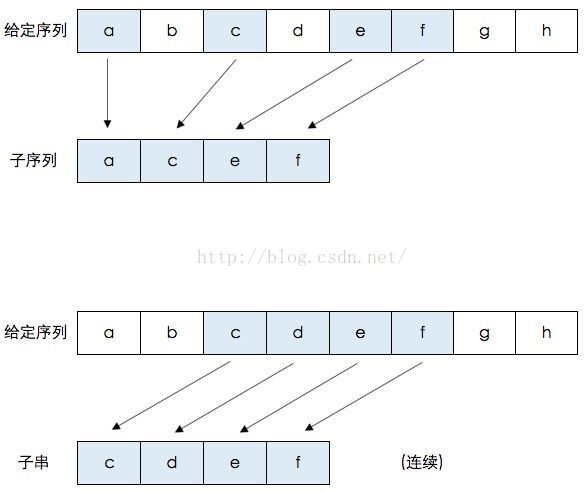
- 子序列(subsequence): 一个特定序列的子序列就是将给定序列中零个或多个元素去掉后得到的结果(不改变元素间相对次序)。例如序列<A,B,C,B,D,A,B>的子序列有:<A,B>、<B,C,A>、<A,B,C,D,A>等。
- 公共子序列(common subsequence): 给定序列X和Y,序列Z是X的子序列,也是Y的子序列,则Z是X和Y的公共子序列。例如X=[A,B,C,B,D,A,B],Y=[B,D,C,A,B,A[,那么序列Z=[B,C,A]为X和Y的公共子序列,其长度为3。但Z不是X和Y的最长公共子序列,而序列[B,C,B,A]和[B,D,A,B]也均为X和Y的最长公共子序列,长度为4,而X和Y不存在长度大于等于5的公共子序列。对于序列[A,B,C]和序列[E,F,G]的公共子序列只有空序列[]。
- 最长公共子序列:给定序列X和Y,从它们的所有公共子序列中选出长度最长的那一个或几个。
- 子串: 将一个序列从最前或最后或同时删掉零个或几个字符构成的新系列。区别与子序列,子序列是可以从中间抠掉字符的。cnblogs这个字符串中子序列有多少个呢?很显然有27个,比如其中的cb,cgs等等都是其子序列
策略选择
数据结构:线性数组
算法思想:动态规划
算法设计
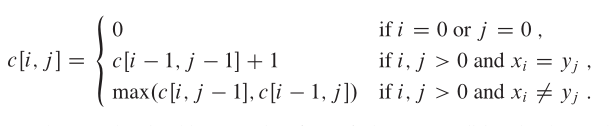
设X=x1,x2,x3,x4…,xm,Y=y1,y2,y3,y4…,yn为两个序列,Z=z1,z2,z3,z4…,zk是他们的任意公共子序列.所以如果用一个二维数组C表示字符串X和Y中对应的前i,前j个字符的LCS的长度话。
确定状态转移变量Zk-1。它表示X的子串Xn-1和Y的子串Ym-1的最长公共子序列。
确定状态转移方程:
- 如果xm = yn,则zk = xm = yn 且 Zk-1是Xm-1和Yn-1的一个LCS
- 如果xm != yn 且 zk != xm,则Z是Xm-1和Y的一个LCS
- 如果xm != yn 且 zk != yn,则Z是X和Yn-1的一个LCS
状态转移过程
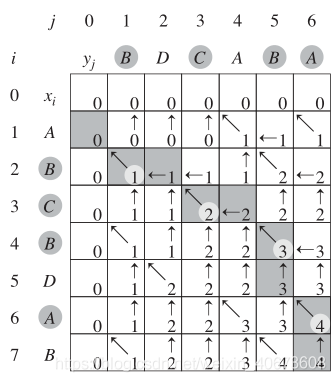
算法分析
- 时间复杂度为O(m*n)
算法实现
1 |
|
本博客所有文章除特别声明外,均采用 CC BY-NC-SA 4.0 许可协议。转载请注明来源 Estom的博客!
相关推荐

2022-04-18
05 数组
数组是值的有序集合。数组中的每个值叫做一个元素,而每个元素在数组中都有一个唯一的位置。这个位置用数字表示,叫做索引数据;用字符串表示,叫做关联数组。 JavaScript 数组是无类型的:数组的元素可以是任何类型,例如字符串、数字值、布尔值等,而且每个数组中的不同元素可能是不同类型。 JavaScript 数组是动态的:根据需要,可以动态地向数组插入新的元素,或者从数组中删除指定的元素。 一维数组定义数组数组的最大作用就是用于存储多个值。定义数组分别两种形式: 使用数组字面量方式: 12var arr1 = [ ];var arr2 = [ 1, "a", true ]; 使用数组关键字方式: 12var arr1 = Array( );var arr2 = Array( 1, "a", true ); 值得注意的是: 在一个数组中的不同元素可以是不同数据类型。 索引数组索引数组就是存储元素的位置使用数字值来表示,一般称之为下标或角标。具体创建方式如下述代码: 1234var arr = [];arr[0] = 1;arr[...
2022-12-04
08-循环遍历
# 1. v-for遍历数组 123456789101112131415161718192021222324252627282930<!DOCTYPE html><html lang="en"><head> <meta charset="UTF-8"> <meta name="viewport" content="width=device-width, initial-scale=1.0"> <meta http-equiv="X-UA-Compatible" content="ie=edge"> <title>Document</title></head><body> <div id="app"> <!-- 1.遍历过程没有使用索引(下标值) --> <ul> ...
2021-03-18
1.1 重复问题
1 重复数字问题问题描述 找出数组中重复的数字。在一个长度为 n 的数组 nums 里的所有数字都在 0~n-1 的范围内。数组中某些数字是重复的,但不知道有几个数字重复了,也不知道每个数字重复了几次。请找出数组中任意一个重复的数字。 问题链接 问题分析 重复问题的解决大部分都可以使用哈希表。然后根据元素提供的额外属性采用哈希表的变种。 如本题中提供了额外的限制——0-n-1范围内的数字。那么除了用提供的unordered_set。也可以使用数组作为哈希表,数组的下标作为键,数组的值为值。于是很容易想到第二种方法的改进,即第三种方法。 问题分类 线性数据结构 查找问题 枚举法。 1.1 重复数字问题——排序策略选择算法设计 使用快速排序 寻找第一组相邻的重复数字。 正确性证明算法分析 时间复杂度O(nlogn) 空间复杂度O(logn) 算法实现12345678910// 排序方法。排序后出现连续重复数字。int findRepeatNumber1(vector<int>& nums) { sort(nums.begin(),nums...

2020-09-25
8位运算
二进制运算逐元素位操作 方法 描述 bitwise_and(x1, x2, /[, out, where, …]) 按元素计算两个数组的按位与。 bitwise_or(x1, x2, /[, out, where, casting, …]) 按元素计算两个数组的按位或。 bitwise_xor(x1, x2, /[, out, where, …]) 按元素计算两个数组的按位XOR。 invert(x, /[, out, where, casting, order, …]) 按元素计算按位求逆,或按位求非。 left_shift(x1, x2, /[, out, where, casting, …]) 将整数的位向左移动。 right_shift(x1, x2, /[, out, where, …]) 向右移整数的位。 打包二进制 方法 描述 packbits(a[, axis, bitorder]) 将二进制值数组的元素打包为uint8数组中的位。 unpackbits(a...

2021-03-26
6.10 差分数组
差分数组Sparse Array1 定义 定义:原数组为a,差分数组为d,那么有$$d[i] = a[i] - a[i - 1]$$ 其实差分数组是一个辅助数组,从侧面来表示给定某一数组的变化,一般用来对数组进行区间修改的操作 2 性质 a[i]等于d[i]的前缀和 $$a[i] = \sum_{0}^i d_i$$ d[i]等于a[i]两个临近元素的差$$d[i] = a[i] - a[i - 1]$$ 3 应用区间修改 当对一个区间进行增减某个值的时候,他的差分数组对应的区间左端点的值会同步变化,而他的右端点的后一个值则会相反地变化。他们的差分数组其实是不会变化的。 例如:将区间【1,4】的数值全部加上3 [l,r]区间内的数加k可以表示为如下形式: $$d[l]+k\d[r+1]-k$$ 元素求值 既然我们要对区间进行修改,那么差分数组的作用一定就是求多次进行区间修改后的数组。 直接反过来即得$$a[i]=a[i-1]+d[i]$$ 实例1 区间涂色问题描述 N个气球排成一排,从左到右依次编号为1,2,3…...

2021-09-02
6-数组
6 数组6.1 数组的定义数组在定义时就需要声明其元素数量和类型: 12// T 即元素类型var 数组变量名 [元素数量] T 如:var a [5]int. 数组的长度必须是常量,并且长度是数组类型的一部分,一旦定义,长度不能变。所以,[5]int 和 [10]int 是不同的类型。 1234567891011package mainimport "fmt"func main() { var a [3]bool var b [6]bool // a的类型是-[3]bool,b 的类型是-[6]bool fmt.Printf("a的类型是-%T,b 的类型是-%T", a, b)} 数组可以通过下表进行访问,下标从 0 开始,最后一个元素下标为:len-1 6.2 数组的初始化6.2.1 方式1——通过初始化列表设置值1234567891011121314151617package mainimport "fmt"func main() { // 未初始化时,元素取类型默认值(零值):...