4.7 观察者
观察者模式
别名
- Dependency
- Publish-Subscribe
观察者模式好牛啊,在不同的代码层次有这不同的名称但是大同小异。
- 在java代码层就是观察着模式
- 在socket网络编程、IO编程中(netty、springWebFlux、sofarpc)就是Reactor模式
- 在操作系统中就是IO多路复用的一种策略
- 在UI框架中就是Listener,事件监听机制和响应机制
- 在Spring框架中也有事件监听模型。
- 在web网站开发中,被称为响应式编程。
服务发现机制。以下并不是观察者模式的范畴,是一种更加宏观的机制,可能使用了观察者模式去发现。- javaSPI。服务提供者接口
- 在微服务中就是注册中心的发布订阅过程。发布者订阅者、提供者消费者。
- 在消息中间件中就是发布订阅模式。
https://juejin.cn/post/6993999863159455752
意图
定义对象间的一种一对多的依赖关系,当一个对象的状态发生改变时,所有依赖于它的对象都得到通知并被自动更新。
结构
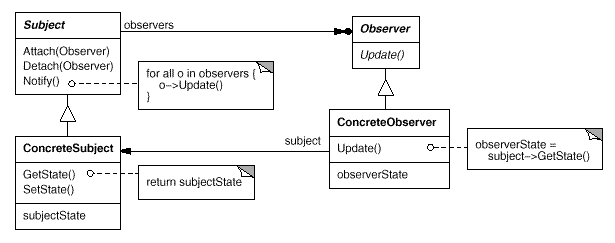
参与者
Subject
Subject 知道它的 Observer。可以有任意多个 Observer 观察同一个 Subject。
提供注册和删除 Observer 的接口。
Observer
- 为那些在 Subject 发生改变时需要获得通知的对象定义一个 Update 接口。
ConcreteSubject
将有关状态存储各个 ConcreteObserver 对象。
当它的状态发生改变时,想它的各个 Observer 发出通知。
ConcreteObserver
维护一个指向 ConcreteSubject 对象的引用。
存储有关状态,这些状态应该与 ConcreteSubject 的状态保持一致。
实现 Observer 的更新接口以使自身状态与 ConcreteSubject 状态保持一致。
适用性
在以下情况下可以使用 Observer 模式:
当一个抽象模型有两个方面,其中一个方面依赖于另一个方面。将这二者封装在独立的对象中以使它们可以各自独立地改变和复用。
当对一个对象的改变需要同时改变其他对象,而不知道具体有多少对象有待改变。
当一个对象必须通知其他对象,而它又不能假定其他对象时谁。
效果
目标与观察者间的抽象耦合。
支持广播通信。
意外的更新。因为 Observer 并不知道其他 Observer 的存在,所以对改变 Subject
的最终代价一无所知。
相关模式
- 可以使用 Mediator 模式封装复杂的更新语义,充当 Subject 与 Observer
之间的中介者。
Implementation
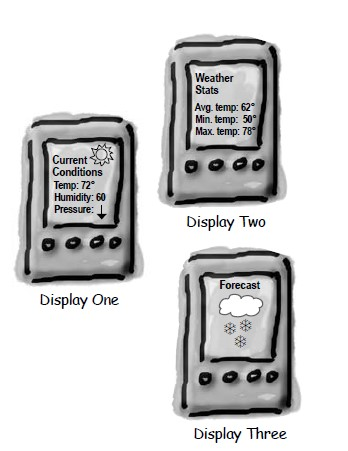
天气数据布告板会在天气信息发生改变时更新其内容,布告板有多个,并且在将来会继续增加。
1 | public interface Subject { |
1 | public class WeatherData implements Subject { |
1 | public interface Observer { |
1 | public class StatisticsDisplay implements Observer { |
1 | public class CurrentConditionsDisplay implements Observer { |
1 | public class WeatherStation { |
1 | CurrentConditionsDisplay.update: 0.0 0.0 0.0 |
JDK
本博客所有文章除特别声明外,均采用 CC BY-NC-SA 4.0 许可协议。转载请注明来源 Estom的博客!
相关推荐

2020-09-26
index
事件处理Matplotlib支持使用GUI中立事件模型进行事件处理,因此您可以连接到Matplotlib事件,而无需了解Matplotlib最终将插入哪个用户界面。 这有两个好处:你编写的代码将更加可移植,Matplotlib事件就像数据坐标空间和事件发生在哪些轴之类的东西,所以你不必混淆低级转换细节来自画布空间到数据空间。还包括对象拾取示例。
2021-04-10
2.3 工厂方法
工厂方法别名 虚构造器 (Virtual Constructor) 意图 定义一个用于创建目标对象的接口,让子类决定实例化哪一个目标类。Factory Method 使一个类的实例化延迟到其子类。 Define an interface for creating an object, but let subclasses decide which class to instantiate.Factory Method lets a class defer instantiation to subclasses. 结构 参与者 Product 定义工厂方法所创建的对象的接口(Interface)。 ConcreteProduct 实现 Product 接口。 Creator 声明工厂方法,该方法返回一个 Product 类型的对象。 Creator也可以定义一个工厂方法的缺省实现,它返回一个缺省的 ConcreteProduct 对象。 可以调用工厂方法以创建一个 Product 对象。 ConcreteCreator 重定义(Override)工厂方法以创...

2020-09-26
looking_glass
镜子例如,使用鼠标事件模拟用于检查数据的镜子。 12345678910111213141516171819202122232425262728293031323334353637383940414243444546474849505152import numpy as npimport matplotlib.pyplot as pltimport matplotlib.patches as patches# Fixing random state for reproducibilitynp.random.seed(19680801)x, y = np.random.rand(2, 200)fig, ax = plt.subplots()circ = patches.Circle((0.5, 0.5), 0.25, alpha=0.8, fc='yellow')ax.add_patch(circ)ax.plot(x, y, alpha=0.2)line, = ax.plot(x, y, alpha=1.0, clip_path=circ)ax.set_titl...

2022-12-05
java开发人员最常犯的10中错误
[TOC] 一、把数组转成ArrayList为了将数组转换为ArrayList,开发者经常会这样做: 1List<String> list = Arrays.asList(arr); 使用Arrays.asList()方法可以得到一个ArrayList,但是得到这个ArrayList其实是定义在Arrays类中的一个私有的静态内部类。这个类虽然和java.util.ArrayList同名,但是并不是同一个类。java.util.Arrays.ArrayList类中实现了set(), get(), contains()等方法,但是并没有定义向其中增加元素的方法。也就是说通过Arrays.asList()得到的ArrayList的大小是固定的。 如果在开发过程中,想得到一个真正的ArrayList对象(java.util.ArrayList的实例),可以通过以下方式: 1ArrayList<String> arrayList = new ArrayList<String>(Arrays.asList(arr)); java.util.Array...

2020-09-26
demo_tight_layout
使用紧凑布局调整轴的大小tight_layout 尝试调整图中子图的大小,以便轴对象和轴上的标签之间不会重叠。 有关详细信息,请参阅 “约束布局指南”;有关替代方法,请参阅 “严格布局” 指南。 12345678910111213import matplotlib.pyplot as pltimport itertoolsimport warningsfontsizes = itertools.cycle([8, 16, 24, 32])def example_plot(ax): ax.plot([1, 2]) ax.set_xlabel('x-label', fontsize=next(fontsizes)) ax.set_ylabel('y-label', fontsize=next(fontsizes)) ax.set_title('Title', fontsize=next(fontsizes)) 123fig, ax = plt.subplots()example_plot(ax)pl...

2022-11-24
mockito
官网http://mockito.org/API http://docs.mockito.googlecode.com/hg/org/mockito/Mockito.html抄笔记,https://www.letianbiji.com/java-mockito/mockito-test-isolate.html 基本概念单元测试UT工作一段时间后,才真正意识到代码质量的重要性。虽然囫囵吞枣式地开发,表面上看来速度很快,但是给后续的维护与拓展制造了很多隐患。作为一个想专业但还不专业的程序员,通过构建覆盖率比较高的单元测试用例,可以比较显著地提高代码质量。如后续需求变更、版本迭代时,重新跑一次单元测试即可校验自己的改动是否正确。 是什么Mockito是mocking框架,它让你用简洁的API做测试。而且Mockito简单易学,它可读性强和验证语法简洁。 Stub和Mock异同相同:Stub和Mock都是模拟外部依赖不同:Stub是完全模拟一个外部依赖, 而Mock还可以用来判断测试通过还是失败 与Junit框架一同使用请MockitoAnnotations.initMocks(...