3 在对象之间搬移特性
3 在对象之间搬移特性
1 Move Method(搬移函数)
如果某个函数使用另一个对象的次数比使用自己所驻对像的次数多,就可以使用Move Method将函数搬移到另一个对象。当函数中用到了原来对象的属性时,搬移后可以把原来对象this作为入参。
重构示例7
1 | // 重构前 |
1 | // 重构后 |
2 Move Field(搬移字段)
与Move Method类似,对于一个字段,如果在其所驻类之外的另一个类中有更多函数使用了它,就可以使用Move Field将该字段搬移到另一个对象中。需要注意的是,搬移之后需要在新的类中提供该字段的访问函数,否则原对象就无法访问到该字段了。
3 Extract Class(提炼类)
当一个类所承担的责任太多时,就可以使用Extract Class手法,根据单一职责原则,将类的一些函数和字段抽离出来,封装成一个新的类。
重构示例8
1 | // 重构前 |
1 | // 重构后 |
4 Inline Class(将类内联化)
Inline Class与Extract Class相反,如果某个类所做的事情太少以至于不值得作为一个类存在,则将这个类的所有属性/函数搬移到另一个类中,然后删除原来的类。
5 Hide Delegate(隐藏“委托关系”)
Hide Delegate可以防止信息泄漏,避免模块之间的耦合。如果某个Client先通过服务对象A的字段得到另一个对象B,然后调用对象B的函数,那么Client就必须知晓这一层的委托关系。这时就产生了信息的泄漏,对象A将对象B泄漏给了Client。如果委托关系变了,Client也必须跟着改变,这样模块之间的耦合就太多了。
在服务类上建立Client所需的所有函数,可以隐藏委托关系。
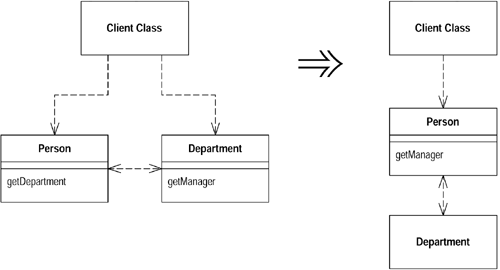
重构示例9
1 | // 重构前 |
1 | // 重构后 |
6 Remove Middle Man(移除中间人)
该重构手法与Hide Delegate刚好相反,如果某个类做了过多的简单委托动作,则把该类移除,让客户端直接调用受托类。
本博客所有文章除特别声明外,均采用 CC BY-NC-SA 4.0 许可协议。转载请注明来源 Estom的博客!
相关推荐

2020-09-26
whats_new_99_spines
0.99版本新增Spines对象12345678910111213141516171819202122232425262728293031323334353637383940414243444546import matplotlib.pyplot as pltimport numpy as npdef adjust_spines(ax,spines): for loc, spine in ax.spines.items(): if loc in spines: spine.set_position(('outward',10)) # outward by 10 points else: spine.set_color('none') # don't draw spine # turn off ticks where there is no spine if 'left' in spines: ax.yaxis...

2020-09-26
path_patch
PathPatch对象此示例显示如何通过Matplotlib的API创建 Path 和 PathPatch 对象。 12345678910111213141516171819202122232425262728293031import matplotlib.path as mpathimport matplotlib.patches as mpatchesimport matplotlib.pyplot as pltfig, ax = plt.subplots()Path = mpath.Pathpath_data = [ (Path.MOVETO, (1.58, -2.57)), (Path.CURVE4, (0.35, -1.1)), (Path.CURVE4, (-1.75, 2.0)), (Path.CURVE4, (0.375, 2.0)), (Path.LINETO, (0.85, 1.15)), (Path.CURVE4, (2.2, 3.2)), (Path.CURVE4, (3, 0.05)), (Path.CUR...

2021-05-09
30 快速入门
快速入门目录 快速入门 张量 数据集和数据加载器 转换 建立模型 自动区分 优化循环 保存,加载和使用模型 0 包加载PyTorch有两个处理数据的原语: torch.utils.data.DataLoader和torch.utils.data.Dataset。 Dataset存储样本及其相应的标签,并DataLoader在周围包裹一个可迭代的对象Dataset。 123456import torchfrom torch import nnfrom torch.utils.data import DataLoaderfrom torchvision import datasetsfrom torchvision.transforms import ToTensor, Lambda, Composeimport matplotlib.pyplot as plt 1 数据库和数据导入PyTorch提供了特定领域的库,例如TorchText, TorchVision和TorchAudio,所有这些库都包含数据集。在本教程中,我们将使用TorchVision数据集。 12345678...

2020-09-26
quad_bezier
Bezier曲线此示例展示 PathPatch 对象以创建Bezier多曲线路径修补程序。 1234567891011121314151617import matplotlib.path as mpathimport matplotlib.patches as mpatchesimport matplotlib.pyplot as pltPath = mpath.Pathfig, ax = plt.subplots()pp1 = mpatches.PathPatch( Path([(0, 0), (1, 0), (1, 1), (0, 0)], [Path.MOVETO, Path.CURVE3, Path.CURVE3, Path.CLOSEPOLY]), fc="none", transform=ax.transData)ax.add_patch(pp1)ax.plot([0.75], [0.25], "ro")ax.set_title('The red point should be on the...

2021-03-20
45
5.8. 成对的矩阵, 类别和核函数校验者: @FontTian @numpy翻译者: @程威 The sklearn.metrics.pairwise 子模块实现了用于评估成对距离或样本集合之间的联系的实用程序。 本模块同时包含距离度量和核函数,对于这两者这里提供一个简短的总结。 距离度量是形如 d(a, b) 例如 d(a, b) < d(a, c) 如果对象 a 和 b 被认为 “更加相似” 相比于 a 和 c. 两个完全相同的目标的距离是零。最广泛使用的示例就是欧几里得距离。 为了保证是 ‘真实的’ 度量, 其必须满足以下条件: 对于所有的 a 和 b,d(a, b) >= 0 正定性:当且仅当 a = b时,d(a, b) == 0 对称性:d(a, b) == d(b, a) 三角不等式:d(a, c) <= d(a, b) + d(b, c) 核函数是相似度的标准. 如果对象 a 和 b 被认为 “更加相似” 相比对象 a...

2020-09-26
pie_features
基本饼图演示一个基本的饼图和一些额外的功能。 除了基本饼图外,此演示还显示了以下几个可选功能: 切片标签。 自动标记百分比。 用 explode 偏移切片。 投影。 自定义起始角度 请注意,自定义起点角度: 默认的起始角度(startangle)为0,这将在正x轴上开始“Frogs”切片。此示例将 startangle设置为90 ,以便将所有对象逆时针旋转90度,并且青蛙切片从正y轴开始。 12345678910111213import matplotlib.pyplot as plt# Pie chart, where the slices will be ordered and plotted counter-clockwise:labels = 'Frogs', 'Hogs', 'Dogs', 'Logs'sizes = [15, 30, 45, 10]explode = (0, 0.1, 0, 0) # only "explode" the 2nd slice (i....