04 Java线程池
1 Executor概述
概述
Executor framework框架由三个主要接口(以及许多子接口)组成,即Executor , ExecutorService和ThreadPoolExecutor 。
- 该框架主要将任务创建和执行分开。 任务创建主要是样板代码,并且很容易替换。
- 对于执行者,我们必须创建实现Runnable或Callable接口的任务,并将其发送给执行者。
- 执行程序在内部维护一个(可配置的)线程池,以通过避免连续产生线程来提高应用程序性能。
- 执行程序负责执行任务,并使用池中的必要线程运行它们。
分类
Executor 管理多个异步任务的执行,而无需程序员显式地管理线程的生命周期。这里的异步是指多个任务的执行互不干扰,不需要进行同步操作。
- CachedThreadPool:缓存线程池执行程序 –创建一个线程池,该线程池可根据需要创建新线程,但在可用时将重用以前构造的线程。 如果任务长时间运行,请勿使用此线程池。 如果线程数超出系统可以处理的范围,则可能导致系统崩溃。
- FixedThreadPool:固定线程池执行程序 –创建一个线程池,该线程池可重用固定数量的线程来执行任意数量的任务。 如果在所有线程都处于活动状态时提交了其他任务,则它们将在队列中等待,直到某个线程可用为止。 最适合现实生活中的大多数用例。
- SingleThreadExecutor:相当于大小为 1 的 FixedThreadPool,单线程池执行程序 –创建单线程以执行所有任务。 当您只有一个任务要执行时,请使用它。
- ScheduledThreadPool:调度线程池执行程序 –创建一个线程池,该线程池可以调度命令以在给定延迟后运行或定期执行。
- ForkJoinPool:分支合并线程池,适合用于处理复杂任务。初始化线程容量与 CPU 核心数相关。线程池中运行的内容必须是 ForkJoinTask 的子类型(RecursiveTask,RecursiveAction)。
- WorkStealingPool:JDK1.8 新增的线程池。工作窃取线程池。当线程池中有空闲连接时,自动到等待队列中窃取未完成任务,自动执行。初始化线程容量与 CPU 核心数相关。此线程池中维护的是精灵线程。ExecutorService.newWorkStealingPool();
ThreadPoolExecutor类具有四个不同的构造函数,但是由于它们的复杂性,Java并发API提供了Executors类来构造执行程序和其他相关对象。 尽管我们可以使用其构造函数之一直接创建ThreadPoolExecutor ,但是建议使用Executors类。
1 | public static void main(String[] args) { |
使用
- 通过executors工具类创建.Executors是一个实用程序类,它提供用于创建接口实现的工厂方法。
1 | //Executes only one thread |
- 创建ExecutorService。我们可以选择ExecutorService接口的实现类,然后直接创建它的实例。 下面的语句创建一个线程池执行程序,该线程池执行程序的最小线程数为10,最大线程数为100,存活时间为5毫秒,并且有一个阻塞队列来监视将来的任务。
1 | import java.util.concurrent.ExecutorService; |
- Execute Runnable tasks
- void execute(Runnable task) –在将来的某个时间执行给定命令。
- Future submit(Runnable task)可运行Future submit(Runnable task) –提交要执行的可运行任务,并返回代表该任务的Future 。 Future的get()方法成功完成后将返回null 。
- 提交可运行任务以执行并返回代表该任务的Future 。 Future的get()方法将在成功完成后返回给定的result
1 |
|
- Execute Callable tasks
- Future submit(callableTask) –提交一个执行返回值的任务,并返回代表该任务的未决结果的未来。
- List
invokeAll(Collection tasks) –执行给定的任务,并when all complete返回保存其状态和结果的Future列表。 注意,仅当所有任务完成时结果才可用。请注意,已完成的任务可能已正常终止,也可能引发异常。 - List
invokeAll(Collection task,timeOut,timeUnit) –执行给定的任务,并在所有完成或超时到期时返回保存其状态和结果的Future列表。
1 |
|
2 FixedThreadPool
- 如果有任何任务引发异常,则应用程序将捕获该异常并重新启动该任务。
- 如果有任何任务运行完毕,应用程序将注意到并重新启动任务。
1 | package com.howtodoinjava.multiThreading.executors; |
3 ForkJoinPool
主要用于并行计算中,和 MapReduce 原理类似,都是把大的计算任务拆分成多个小任务并行计算。
1 | public class ForkJoinExample extends RecursiveTask<Integer> { |
1 | public static void main(String[] args) throws ExecutionException, InterruptedException { |
ForkJoin 使用 ForkJoinPool 来启动,它是一个特殊的线程池,线程数量取决于 CPU 核数。
1 | public class ForkJoinPool extends AbstractExecutorService |
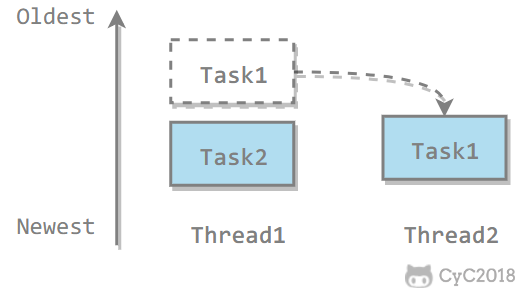
ForkJoinPool 实现了工作窃取算法来提高 CPU 的利用率。每个线程都维护了一个双端队列,用来存储需要执行的任务。工作窃取算法允许空闲的线程从其它线程的双端队列中窃取一个任务来执行。窃取的任务必须是最晚的任务,避免和队列所属线程发生竞争。例如下图中,Thread2 从 Thread1 的队列中拿出最晚的 Task1 任务,Thread1 会拿出 Task2 来执行,这样就避免发生竞争。但是如果队列中只有一个任务时还是会发生竞争。
4 ScheduledThreadPool
而是您可能要在一段时间后执行任务或定期执行任务。 为此,Executor框架提供ScheduledThreadPoolExecutor类。
- 实现一个任务
1 | class Task implements Runnable |
- Execute a task after a period of time.
1 |
|
- Execute a task periodically
1 | public class ScheduledThreadPoolExecutorExample |
本博客所有文章除特别声明外,均采用 CC BY-NC-SA 4.0 许可协议。转载请注明来源 Estom的博客!
相关推荐

2021-09-07
9.1-chinese
9.1 线程池很多公司里,雇员通常会在办公室度过他们的办公时光(偶尔也会外出访问客户或供应商),或是参加贸易展会。虽然外出可能很有必要,并且可能需要很多人一起去,不过对于一些特别的雇员来说,一趟可能就是几个月,甚至是几年。公司要给每个雇员都配一辆车,这基本上是不可能的,不过公司可以提供一些共用车辆;这样就会有一定数量车,来让所有雇员使用。当一个员工要去异地旅游时,那么他就可以从共用车辆中预定一辆,并在返回公司的时候将车交还。如果某天没有闲置的共用车辆,雇员就得不延后其旅程了。 线程池就是类似的一种方式,在大多数系统中,将每个任务指定给某个线程是不切实际的,不过可以利用现有的并发性,进行并发执行。线程池就提供了这样的功能,提交到线程池中的任务将并发执行,提交的任务将会挂在任务队列上。队列中的每一个任务都会被池中的工作线程所获取,当任务执行完成后,再回到线程池中获取下一个任务。 创建一个线程池时,会遇到几个关键性的设计问题,比如:可使用的线程数量,高效的任务分配方式,以及是否需要等待一个任务完成。 在本节,我们将看到线程池是如何解决这些问题的,从最简单的线程池开始吧! 9.1.1 最...
2021-09-07
4.2-chinese
4.2 使用期望等待一次性事件假设你乘飞机去国外度假。当你到达机场,并且办理完各种登机手续后,你还需要等待机场广播通知你登机,可能要等很多个小时。你可能会在候机室里面找一些事情来打发时间,比如:读书,上网,或者来一杯价格不菲的机场咖啡,不过从根本上来说你就在等待一件事情:机场广播能够登机的时间。给定的飞机班次再之后没有可参考性;当你在再次度假的时候,你可能会等待另一班飞机。 C++标准库模型将这种一次性事件称为期望(future)。当一个线程需要等待一个特定的一次性事件时,在某种程度上来说它就需要知道这个事件在未来的表现形式。之后,这个线程会周期性(较短的周期)的等待或检查,事件是否触发(检查信息板);在检查期间也会执行其他任务(品尝昂贵的咖啡)。另外,在等待任务期间它可以先执行另外一些任务,直到对应的任务触发,而后等待期望的状态会变为就绪(ready)。一个“期望”可能是数据相关的(比如,你的登机口编号),也可能不是。当事件发生时(并且期望状态为就绪),这个“期望”就不能被重置。 在C++标准库中,有两种“期望”,使用两种类型模板实现,声明在头文件中: 唯一期望(unique ...

2021-09-07
9.3-chinese
9.3 本章总结在本章中,我们了解各种“高级”线程管理技术:线程池和中断线程。也了解了如何使用本地任务队列,使用任务窃取的方式减小同步开销,提高线程池的吞吐量;等待子任务完成的同时执行队列中其他任务,从而来避免死锁。 也了解了使用线程去中断另一个处理线程的各种方式,比如:使用特定的断点和函数执行中断,要不就是使用某种方法,对阻塞等待进行中断。
2022-12-19
07 Java线程安全
Java 并发1 线程安全概述线程不安全示例如果多个线程对同一个共享数据进行访问而不采取同步操作的话,那么操作的结果是不一致的。 以下代码演示了 1000 个线程同时对 cnt 执行自增操作,操作结束之后它的值有可能小于 1000。 123456789101112public class ThreadUnsafeExample { private int cnt = 0; public void add() { cnt++; } public int get() { return cnt; }} 123456789101112131415public static void main(String[] args) throws InterruptedException { final int threadSize = 1000; ThreadUnsafeExample example = new ThreadUnsafeExample();...

2022-11-01
8 SpringQuartz
1 SpringBoot-quartz基本用法添加依赖1234567891011<!-- 实现对 Spring MVC 的自动化配置 --><dependency> <groupId>org.springframework.boot</groupId> <artifactId>spring-boot-starter-web</artifactId></dependency><!-- 实现对 Quartz 的自动化配置 --><dependency> <groupId>org.springframework.boot</groupId> <artifactId>spring-boot-starter-quartz</artifactId></dependency> 创建任务创建job 12345678910111213141516171819@Slf4jpublic class FirstJo...
2022-12-05
04.详解 ThreadPoolExecutor 的参数含义及源码执行流程?
详解 ThreadPoolExecutor 的参数含义及源码执行流程?线程池是为了避免线程频繁的创建和销毁带来的性能消耗,而建立的一种池化技术,它是把已创建的线程放入“池”中,当有任务来临时就可以重用已有的线程,无需等待创建的过程,这样就可以有效提高程序的响应速度。但如果要说线程池的话一定离不开**ThreadPoolExecutor,在阿里巴巴的《Java开发手册》中是这样规定线程池的:线程池不允许使用Executors去创建,而是通过ThreadPoolExecutor**的方式,这样的处理方式让写的读者更加明确线程池的运行规则,规避资源耗尽的风险。 说明:Executors 返回的线程池对象的弊端如下: 1)FixedThreadPool 和 SingleThreadPool:允许的请求队列长度为 Integer.MAX_VALUE,可能会堆积大量的请求,从而导致 OOM(Out Of Memory) 2)CachedThreadPool 和 ScheduledThreadPool:允许的创建线程数量为 Integer.MAX_VALUE,可能会创建大量的线程,从而导致 ...